


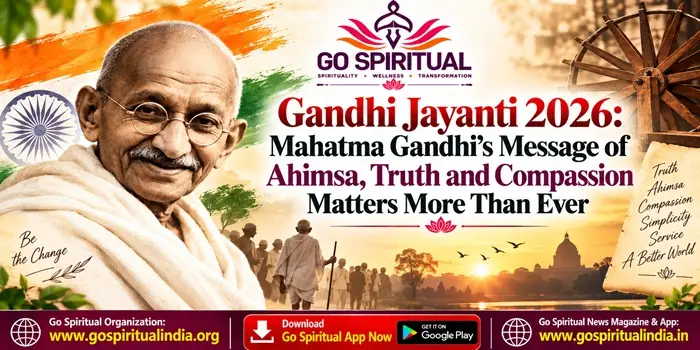

On the 157th birth anniversary of Mahatma Gandhi, Go Spiritual reflects on a philosophy that went far beyond politics—reminding humanity that true strength lies in non-violence, simplicity, self-discipline, compassion and the courage to live by one’s conscience.
Mumbai: India is observing Gandhi Jayanti on October 2, 2026, marking the 157th birth anniversary of Mahatma Gandhi, whose ideas of truth, non-violence, simplicity and service continue to carry profound relevance in a world struggling with conflict, intolerance, anger, materialism and social division.
For Go Spiritual News Magazine & App, Gandhi Jayanti is not merely an occasion to remember one of the most important figures of India’s freedom movement. It is also an opportunity to revisit the deeper spiritual foundations of Gandhi’s life and philosophy. His understanding of Ahimsa, Satya, compassion, self-restraint and service presented spirituality not simply as something to be practised through rituals, but as something that must become visible in everyday conduct.
Gandhi’s life demonstrated that non-violence should not be confused with weakness. His philosophy of Ahimsa demanded enormous inner strength because it asked individuals to resist injustice without allowing hatred to dominate their hearts. It required control over anger, ego and the desire for revenge. In that sense, Gandhi’s political philosophy was inseparable from his moral and spiritual search.
The United Nations’ observance of October 2 as the International Day of Non-Violence gives Gandhi’s message a significance extending far beyond India. The UN established the observance in 2007, describing non-violence as a means of promoting a culture of peace, tolerance, understanding and non-violence.
More than seven decades after Gandhi’s death, the world has transformed technologically, economically and socially, but many of the fundamental human problems he confronted remain. Violence continues in different parts of the world. Communities remain divided by identity and ideology. Public discourse can quickly turn hostile. Social media has made communication instantaneous, but it has also created new spaces for anger, abuse, humiliation and hatred.

In such an environment, Ahimsa needs to be understood in a much broader sense. Non-violence is not only the absence of physical violence. It can also mean refusing to deliberately humiliate another person, controlling destructive anger, showing compassion towards vulnerable people, respecting animals and other living beings, protecting nature and learning to disagree without hatred.
This is where Gandhi’s philosophy connects strongly with the spiritual values advocated by Go Spiritual. Compassion cannot remain selective. If spirituality makes us more peaceful during meditation but does not make us kinder towards people, animals and nature, we must ask whether our spiritual practice is truly transforming us.
Gandhi’s emphasis on **truth—Satya—**is equally relevant today. We live in an age of extraordinary access to information, but also one in which misinformation, manipulated narratives and unverified claims can travel around the world within minutes. Truth can easily become secondary to what is viral, emotionally appealing or convenient.
Gandhi’s life reminds us that truth is not merely something we demand from governments, institutions, media or other people. It begins with ourselves. Are we truthful in our relationships? Are we honest in our work? Do we admit our mistakes? Do we have the courage to question our own prejudices? Do we apply the same moral standards to ourselves that we apply to others?
That journey towards inner honesty is deeply spiritual.
Another important dimension of Gandhi’s philosophy was simplicity. Modern society frequently measures progress through consumption—bigger homes, more expensive cars, newer devices, luxury experiences and visible symbols of success. There is nothing inherently wrong with prosperity or comfort, but endless consumption cannot provide endless happiness.
Gandhi’s simplicity asks a question that remains relevant in the age of consumerism: How much do we actually need to live a meaningful life?
Simplicity does not necessarily mean poverty or rejecting modern life. Spiritually understood, simplicity means learning the difference between need and greed. It means possessing things without allowing things to possess our minds. It means recognizing that peace cannot always be purchased and that contentment remains one of life’s greatest forms of wealth.
Gandhi’s commitment to service also offers an important lesson. Spirituality can become self-centred when it focuses exclusively on personal peace, personal enlightenment and personal well-being. Genuine spiritual development should gradually expand our concern beyond ourselves.
Feeding someone who is hungry, helping someone in distress, caring for an elderly person, protecting an animal, supporting someone struggling emotionally, standing beside a vulnerable individual or simply treating another human being with dignity can all become forms of spiritual practice.
Gandhi’s philosophy also invites reflection on our relationship with animals. His understanding of Ahimsa placed compassion for living beings within a wider moral framework. For Go Spiritual, this principle remains especially significant as it promotes vegetarianism, animal compassion and conscious living through awareness rather than coercion. The larger spiritual question is simple: as human beings become more technologically powerful, can we also become more compassionate towards beings that are weaker than us?
Gandhi Jayanti should therefore not become another annual ritual in which we place flowers before a photograph, share a quotation on social media and return the following morning to exactly the same anger, greed, hatred and intolerance.
The greatest tribute to Gandhi would be behavioural.
Can we become slightly less angry? Can we speak more truthfully? Can we consume more consciously? Can we forgive someone? Can we show greater kindness towards animals? Can we listen respectfully to someone whose opinion differs from ours? Can we help someone without expecting recognition? Can we reduce hatred in our language? Can we become more responsible towards the environment?
These may appear to be small acts, but spirituality often begins with small transformations.
For Go Spiritual, Gandhi’s enduring relevance lies precisely here. Spirituality should not only change what we believe; it should change how we behave. Meditation should make us calmer. Prayer should make us more compassionate. Knowledge should make us humbler. Faith should make us kinder. And spiritual awareness should gradually reduce the violence we carry within ourselves.
Gandhi’s philosophy was not without complexities, and aspects of his life and ideas continue to be debated and critically examined. Historical personalities should not be placed beyond scrutiny. Yet the enduring principles associated with his public philosophy—truth, non-violence, self-discipline, simplicity, service and respect for human dignity—continue to provide valuable material for reflection.
On Gandhi Jayanti 2026, perhaps the most meaningful question is therefore not simply what Gandhi taught India more than a century ago.
The more important question is: what are we willing to practise today?
A world with more technology does not automatically become a more humane world. Economic progress does not automatically create compassion. Education does not automatically eliminate hatred. For civilization to progress inwardly as well as outwardly, humanity must continue cultivating values that no machine, institution or law can manufacture for us—truthfulness, empathy, restraint, compassion and respect for life.
That is why Gandhi’s message of Satya and Ahimsa continues to transcend generations. The world may have changed beyond recognition since his time, but the human struggle with anger, ego, greed, violence and hatred remains.
Perhaps the most fitting way to remember Mahatma Gandhi today is therefore not simply to ask the world to become more peaceful.
It is to begin by creating a little more peace within ourselves—and then allowing that peace to shape the way we treat every human being, every living creature and the world around us.
Go Spiritual News Magazine & App
Go Spiritual Organization: www.gospiritualindia.org
Go Spiritual News Magazine & App: www.gospiritualindia.in