


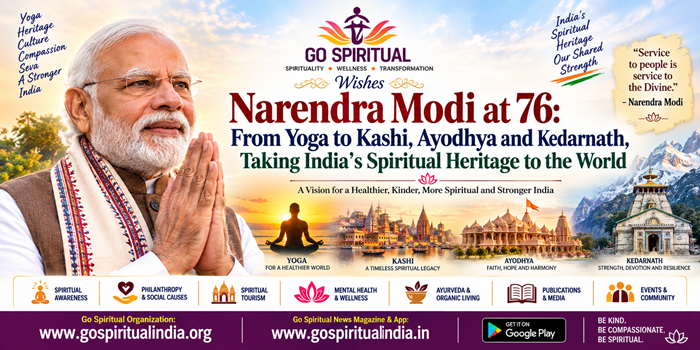

New Delhi: Prime Minister Narendra Modi turned 76 on September 17, 2026, with birthday wishes coming from across India’s political and public life. Born on September 17, 1950, in Vadnagar, Gujarat, Modi has spent more than two decades in elected executive office, first as Chief Minister of Gujarat and, since 2014, as Prime Minister of India.
For a spiritual and wellness publication, however, his birthday also offers an occasion to look at a distinctive dimension of his years in national leadership: the prominent place given to Yoga, pilgrimage centres, temples, Buddhist heritage, Indian philosophy and the idea of “seva” — service — as part of the country’s cultural conversation.
Modi has himself spoken publicly about spirituality as an influence on his life. In an interaction published by the Prime Minister’s Office, he recalled that his inclination towards spirituality began at a young age and referred to the Ramakrishna Paramahamsa and Swami Vivekananda principle of “Jan Seva Hi Prabhu Seva” — service to people is service to the Divine — as an important inspiration.
That relationship between spirituality and service has continued to appear in his public language. In 2026, while speaking at the inauguration of Seva Teerth and Kartavya Bhavan in New Delhi, Modi invoked the idea of “Seva Paramo Dharmah”, describing service as a fundamental duty and connecting governance with responsibility towards people.
The spiritual theme is visible even in some of the events surrounding his birthday this year. In Varanasi, his Lok Sabha constituency and one of Hinduism’s most sacred cities, 76 priests performed a Ganga Abhishek to mark his 76th birthday. In Gujarat, religious and community programmes included prayers, diya-lighting and other events. Separately, public-service campaigns around the birthday have included health camps, blood donation, cleanliness and plantation activities.

Taking Yoga From India to the World
Perhaps the most internationally visible spiritual and wellness initiative associated with Modi’s premiership has been the International Day of Yoga.
During his address to the United Nations General Assembly in September 2014, Modi proposed an International Day of Yoga. The UN General Assembly subsequently adopted June 21 as the International Day of Yoga, with 177 countries co-sponsoring the resolution. The first International Day of Yoga was observed in 2015, with Modi leading a mass yoga programme in New Delhi.
Over the years, he has repeatedly presented Yoga not simply as physical exercise but as a holistic tradition connecting the body, mind, individual consciousness and wellbeing. In June 2026, he again highlighted Yoga’s roots in India’s spiritual heritage, while also sharing a Sanskrit verse honouring Maharishi Patanjali and stressing Yoga’s role in keeping the body healthy and the mind calm.
The globalisation of Yoga is significant from a spiritual perspective because it has taken an ancient Indian discipline into public spaces, schools, institutions and communities around the world. Yoga today is practised in many different religious, secular, fitness and wellness contexts, but its philosophical origins remain deeply connected with India’s spiritual traditions.
Kashi Vishwanath Dham: Reconnecting a Sacred City
Another major initiative during Modi’s tenure has been the redevelopment of the Shri Kashi Vishwanath Dham in Varanasi.
When Modi inaugurated the redeveloped complex in December 2021, he described it as more than a physical structure, calling it a symbol of India’s Sanatan culture and spiritual heritage. The project significantly transformed the area surrounding the historic Kashi Vishwanath Temple and improved connectivity between the temple and the Ganga.
Kashi occupies a unique place in India’s spiritual imagination. For millions of devotees, it is not simply a destination but a teerth — a sacred space associated with Lord Shiva, liberation, knowledge and the timeless relationship between life and death.
The redevelopment of pilgrimage infrastructure in Kashi has also represented a broader policy approach described by the government as “Virasat Bhi, Vikas Bhi” — heritage alongside development. In June 2026, Modi said that efforts ranging from bringing antiquities back to India to strengthening spiritual and pilgrimage infrastructure were intended to reconnect people with India’s traditions.
Mahakal Lok and the Spiritual Consciousness of Ujjain
The development of Shri Mahakal Lok in Ujjain has been another prominent spiritual heritage project associated with Modi’s tenure.
While dedicating the first phase of the project in 2022, Modi linked the restoration and development of India’s pilgrimage centres with the revival of cultural and spiritual consciousness. His address also referred to work at Kashi Vishwanath, Somnath, Kedarnath-Badrinath and other places of faith.
Ujjain, home to the Mahakaleshwar Jyotirlinga, has been a centre of Hindu spirituality, Shaivism, pilgrimage and learning for centuries. The Mahakal Lok project sought to expand the experience and infrastructure around this ancient centre of worship while presenting its religious stories and symbolism to contemporary visitors.
Kedarnath and the Legacy of Adi Shankaracharya
In the Himalayas, the redevelopment of Kedarnath Dham has similarly combined pilgrimage infrastructure with the restoration of spiritual heritage.
In November 2021, Modi inaugurated the reconstructed Samadhi of Adi Shankaracharya and unveiled a statue of the philosopher-saint at Kedarnath. During his address, he spoke about Adi Shankaracharya’s contribution to Indian philosophy and his emphasis on human welfare and a holistic understanding of life.
The symbolism is significant. Adi Shankaracharya occupies an extraordinary position in India’s philosophical history, particularly in the Advaita Vedanta tradition, and is traditionally associated with the revival and consolidation of important spiritual centres across India.
For modern pilgrims, improved infrastructure at places such as Kedarnath can make difficult sacred journeys more accessible, although development in ecologically sensitive Himalayan regions also requires continuing attention to environmental sustainability and carrying capacity.
Ayodhya and the Ram Mandir
The consecration of Ram Lalla at the Ram Mandir in Ayodhya on January 22, 2024 became one of the most prominent religious events of Modi’s premiership.
Ahead of the Pran Pratishtha ceremony, Modi announced that he would undertake an 11-day special spiritual observance, describing his role in the ceremony as a major responsibility and speaking about preparing himself spiritually for the occasion.
The Ram Mandir has profound religious significance for its devotees and has also been at the centre of a long and politically consequential historical dispute. Its consecration therefore carried religious, cultural and political meanings that different Indians may interpret differently. From a spiritual perspective, however, Ayodhya’s renewed prominence has brought the teachings and symbolism associated with Lord Ram — including dharma, maryada, duty, sacrifice and service — back into widespread public discussion.
India’s Buddhist Heritage and the Message of Compassion
Modi’s cultural-spiritual outreach has not been limited to Hindu pilgrimage traditions. His government has also highlighted India’s connection with Buddhism and Lord Buddha’s teachings.
In 2026, Modi inaugurated an international exposition of sacred Piprahwa relics associated with Bhagwan Buddha in New Delhi. Speaking there, he described India’s connection with Buddhist countries as extending beyond diplomacy and economics to bonds of faith and spirituality. He also pointed to infrastructure and visitor facilities being developed at Buddhist sites including Bodh Gaya, Sarnath, Shravasti, Kapilvastu, Kushinagar, Sanchi and others.
In July 2026, Modi welcomed Sarnath’s inscription on the UNESCO World Heritage List, highlighting its association with Buddha and the ideals of wisdom, compassion and harmony.
Buddhism gives India a particularly powerful spiritual connection with many countries across Asia. Buddha’s teachings of compassion, mindfulness, the Middle Path and freedom from suffering also resonate strongly with contemporary conversations around inner wellbeing and mental peace.
Spirituality Beyond Ritual
The larger spiritual question raised by these initiatives goes beyond the construction or redevelopment of temples and pilgrimage corridors.
Indian spirituality has traditionally placed great emphasis on the transformation of the individual. Temples, sacred rivers, pilgrimages, Yoga, meditation and rituals can provide pathways, but the deeper teachings repeatedly return to values such as seva, compassion, self-discipline, truthfulness, detachment, humility and concern for others.
That makes the idea of service particularly relevant on a birthday.
The observance of Modi’s 76th birthday through some programmes centred on service, health, cleanliness, plantation and community activity reflects an interpretation of spirituality in which worship is accompanied by action.
As Prime Minister Narendra Modi completes 76 years of life, his years in office have coincided with a highly visible revival and redevelopment of several of India’s major spiritual and cultural centres and with efforts to give traditions such as Yoga a wider global platform. Supporters see these initiatives as a renewed assertion of India’s civilisational heritage, while debates around the relationship between religion, culture, politics and the state remain part of India’s democratic discourse.
For Go Spiritual, the enduring message of any spiritual journey remains larger than an individual or a government: spirituality ultimately finds its deepest expression when inner awareness becomes compassion, responsibility and service to humanity.
On Prime Minister Narendra Modi’s birthday, that timeless Indian idea — Seva as Sadhana, service as a spiritual practice — offers a message that can extend beyond politics and speak to everyone.