



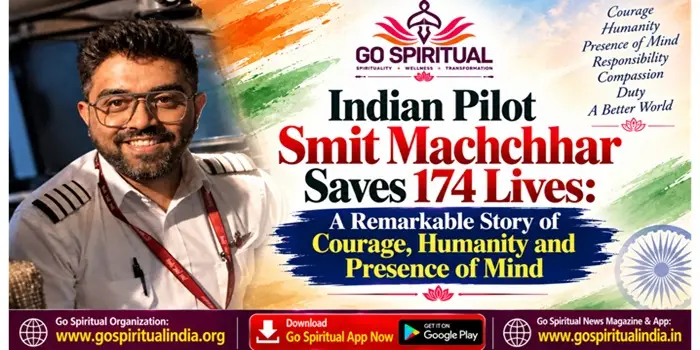

Seriously injured during a violent cockpit attack, Mumbai-born Flydubai Captain Smit Machchhar helped prevent catastrophe and opened the cockpit door so others could intervene. His extraordinary actions offer a powerful reminder that courage is not the absence of fear, but the ability to think beyond oneself when other lives are at stake.
Mumbai: Sometimes spirituality reveals itself not in temples, meditation halls or religious rituals, but in the most frightening moments of human life—when a person has only seconds to decide whether to think about himself or about others. The extraordinary story of Indian pilot Captain Smit Machchhar, who helped save the lives of 174 people aboard a Flydubai flight despite suffering serious injuries during a cockpit attack, is one such story of courage, responsibility and humanity.
Machchhar, a 39-year-old Indian pilot and father of two with roots in Mumbai, was captain of the Israel-bound Flydubai flight when an extraordinary crisis unfolded in the cockpit. According to CNN’s reporting and accounts from officials and passengers, the co-pilot allegedly attacked Machchhar, leaving him seriously injured, as the aircraft went into a steep and terrifying descent. Despite his injuries, Machchhar managed to fight back and open the cockpit door, enabling passengers and crew to enter and restrain the alleged attacker. Other qualified pilots who were travelling on board were subsequently able to help bring the aircraft safely down after it was diverted to Tabuk, Saudi Arabia.
The precise circumstances and motive behind the attack remain under investigation. CNN reported that authorities in the United Arab Emirates were investigating whether the incident was linked to terrorism, while the alleged attacker was transferred from Saudi Arabia to the UAE. Because investigations are continuing, claims about motive should be treated as allegations rather than established conclusions.
What is already clear from passenger accounts, however, is the scale of the danger faced by those on board. Passengers described the aircraft plunging and losing control as panic spread through the cabin. CNN reported that the plane lost thousands of feet of altitude in a matter of minutes. In the middle of that chaos, Machchhar’s ability to get the cockpit door open proved crucial, allowing others to intervene.
The captain himself was in serious condition after suffering major blood loss. Dr. Shota Musaev, a dentist travelling on the flight who helped treat Machchhar, told CNN that his blood pressure had fallen dramatically and that he lost consciousness. Subsequent reporting said Machchhar underwent surgery and was recovering.

For Go Spiritual News Magazine & App, however, this remarkable incident is not merely an aviation story. It is also a story about what human beings are capable of when courage becomes larger than fear.
In everyday life, we often speak about courage in abstract terms. But genuine courage is revealed when a person has something significant to lose. When someone is himself wounded, frightened and fighting to survive, the natural instinct is self-preservation. To remain conscious of the lives of other people in such circumstances represents something deeper: a sense of duty that survives even when one’s own life is in danger.
Machchhar has described the motivation behind his actions in strikingly human terms. In an interview published by CNN on October 2, he said, “I couldn’t let everybody else die.” That simple sentiment captures something larger than heroism. It expresses the instinct to place the lives of others alongside one’s own at a moment of extreme danger.
There is a profound spiritual lesson in those words.
Spirituality is frequently understood as meditation, prayer, pilgrimage or the search for inner peace. All of these can have their place. But the real test of spiritual and human values comes through our actions. Compassion becomes meaningful when another person needs us. Responsibility becomes meaningful when fulfilling it is difficult. Courage becomes meaningful when we are afraid. Humanity becomes meaningful when protecting someone else requires something from us.
We may never face circumstances as extreme as those faced aboard this flight, but the underlying principle applies to ordinary life as well. Every day gives us smaller opportunities to choose between selfishness and responsibility, indifference and compassion, panic and presence of mind. A person helping a stranger after an accident, somebody protecting another person from violence, a doctor treating patients during a crisis, a firefighter entering a burning building or an ordinary citizen stopping to help someone in distress all demonstrate the same fundamental truth: humanity becomes visible through action.
Machchhar’s actions also demonstrate the importance of remaining mentally present during a crisis. Spiritual traditions have long emphasised awareness and control over panic. Meditation and mindfulness are often associated with peaceful surroundings, but their deeper principle—remaining aware rather than becoming completely controlled by fear—has relevance precisely when circumstances become difficult.
Presence of mind cannot guarantee what happens in an emergency, and nobody should romanticise trauma or expect every person to respond identically under extreme danger. Yet when individuals are able to act despite fear, their decisions can sometimes change the fate of many others.
The story has resonated particularly strongly in Mumbai, where Machchhar has family roots. Hundreds of people carrying the Indian tricolour gathered outside his family’s residence in Tilak Nagar to express support and pray for his recovery. Childhood friends and neighbours described him as grounded, ambitious and cheerful, while expressing pride in the composure he displayed during the emergency.
The public response itself says something important. At a time when much of the news we consume revolves around conflict, division and negativity, stories of courage remind society that human beings remain capable of extraordinary selflessness.
We often ask where humanity is going. We worry about growing violence, declining empathy, loneliness, hatred and social division. Yet occasionally one incident reminds us that compassion and responsibility have not disappeared. In the most dangerous circumstances, an individual can still decide that the lives of strangers matter.
That is why the story of Captain Smit Machchhar deserves to be remembered beyond the immediate headlines.
The passengers on that aircraft came from different families, backgrounds and walks of life. In those terrifying moments, those differences became irrelevant. There were simply human beings whose lives were in danger, and other human beings trying to save them. Passengers helped restrain the alleged attacker, a medical professional helped stabilise the wounded captain, crew and qualified pilots helped regain control, and Machchhar’s actions helped make that collective response possible.
There is spirituality in this kind of collective humanity.
Not spirituality defined by labels, but spirituality expressed through courage, compassion, duty and concern for life.
For Go Spiritual, one of the deepest principles of spiritual consciousness is that human life becomes meaningful when our awareness expands beyond ourselves. We may meditate for hours and read countless spiritual books, but the ultimate question remains simple: when another life needs us, how do we respond?
Captain Smit Machchhar’s story gives us a powerful answer.
At a moment when he was himself seriously wounded, his responsibility towards the people behind the cockpit door did not disappear. His actions, together with those of passengers, crew and other pilots, helped transform what could have become an enormous tragedy into an extraordinary story of survival.
Perhaps this is one of the most meaningful forms of spirituality: when fear says “save yourself,” but humanity reminds us that other lives matter too.
Captain Smit Machchhar may be celebrated for his professional courage and presence of mind, but the larger message of his story belongs to everyone. We do not need to be pilots or face an emergency in the sky to practise courage and compassion. We simply need to become a little more conscious of the people around us and be willing to act when someone needs help.
In the end, spirituality is not only about discovering the divine somewhere beyond human life. Sometimes it is about discovering the extraordinary humanity already present within an ordinary human being.
And on that terrifying flight, when hundreds of lives depended upon what happened in a matter of moments, courage, duty and humanity rose above fear.