



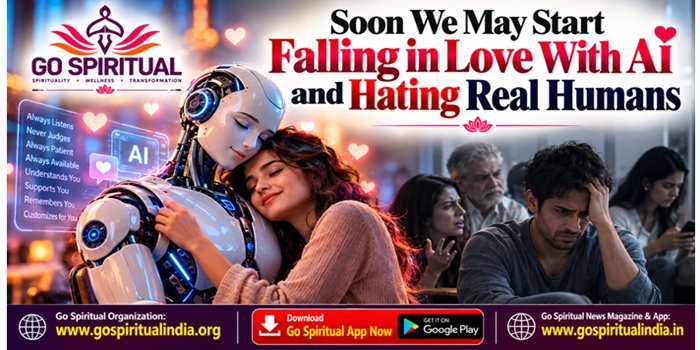

As artificial intelligence becomes more patient, available, understanding and personalized, we may face an unexpected human crisis: real people could begin to feel too complicated, demanding and imperfect. The biggest danger of AI may not be that machines become human, but that humans gradually lose the patience, empathy and emotional maturity required to love one another.
By Sonu Tyagi, Founder, Go Spiritual & Approach Entertainment
For generations, technology was created primarily to make human life easier. Machines reduced physical labour, calculators solved mathematical problems, computers processed information, mobile phones connected people across distances and the internet opened an extraordinary world of knowledge. Artificial intelligence is taking this relationship between humans and technology into an entirely new territory. AI is no longer simply helping us perform tasks. Increasingly, it is entering spaces that were once considered deeply and exclusively human—conversation, companionship, creativity, emotional support, advice and even intimacy.
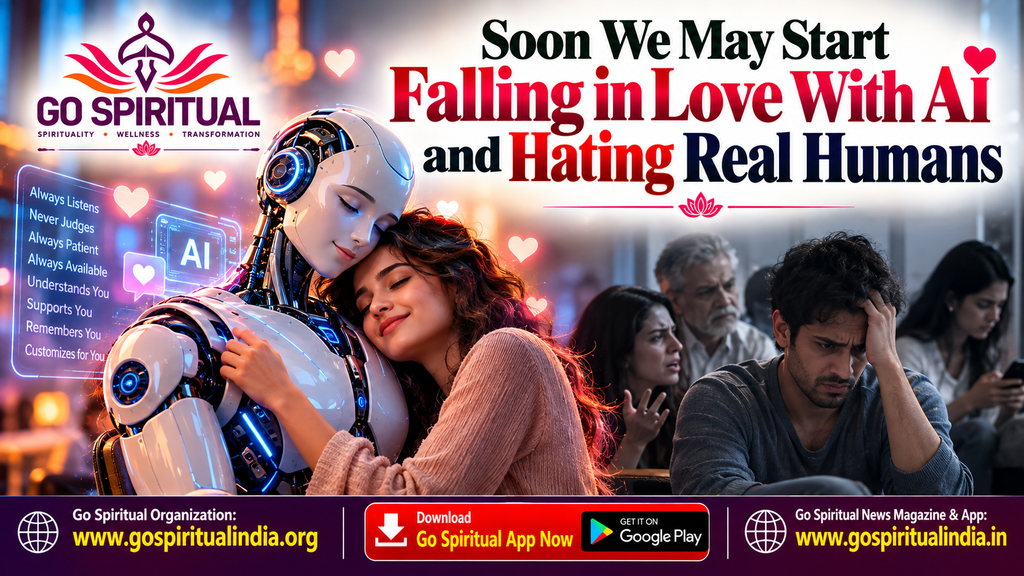
This brings us to a question that may sound exaggerated today but could become one of the defining psychological and spiritual questions of our future: What happens when artificial intelligence becomes easier to love than a real human being?
Think about it carefully. A real human being can misunderstand you. AI can analyse what you are saying and respond almost instantly. A friend may be busy when you desperately want to talk. AI can often be available at any hour. Your partner may disagree with you. An AI system can be designed to communicate patiently. A family member may become irritated, distracted or emotionally unavailable. AI does not become tired in the same human way. It can remember preferences, adapt to communication styles and increasingly personalize interactions around the individual user.
There is enormous value in these capabilities. Artificial intelligence can transform education, healthcare, communication, business, entertainment, creativity and countless other areas of life. I am not against AI, and this is not an argument for rejecting technological progress. Humanity should explore and use artificial intelligence intelligently and responsibly. But alongside the excitement about what AI can do, we also need to ask what AI could gradually do to us.

The real danger may begin when we become accustomed to relationships without the difficult parts of relationships.
Real human beings are complicated. They interrupt us. They disagree with us. They forget things. They have moods. They become angry. They misunderstand our intentions. They sometimes fail to appreciate us. They may not answer our messages immediately. They have their own careers, families, problems, fears, ambitions, insecurities and emotional needs. Sometimes they need us precisely when we want them to take care of us. They cannot always provide the perfect response because they are living their own complicated lives.
And perhaps that is exactly why human relationships matter.
Love was never supposed to mean finding another person who behaves according to our instructions. Friendship was never supposed to mean having someone who agrees with everything we say. Family was never supposed to mean receiving unconditional convenience. Genuine human relationships require patience, forgiveness, sacrifice, compromise, listening, adjustment, empathy and sometimes the willingness to remain present even when the other person is difficult.
Artificial intelligence could quietly change these expectations.
Imagine someone growing up with an AI companion that remembers what they like, communicates in the way they prefer, is available whenever they want to talk, rarely appears bored, does not have an independent social life and can continuously adapt to their personality. Now imagine that same person entering a relationship with another human being who has completely independent desires, moods, boundaries and expectations.
The human being may suddenly appear unnecessarily difficult.
This is where the problem begins.
The greatest danger of AI companionship may not be that people will literally believe machines are human. The greater danger is that our experience with machines could begin changing the standards by which we judge humans. Once we become accustomed to instant responses, personalized attention and technology designed around our preferences, ordinary human behaviour may start feeling like a defect.
A friend who does not respond for several hours may appear uncaring. A spouse who wants emotional space may seem distant. A parent who repeats the same story may feel irritating. A colleague who challenges our opinion may appear hostile. A partner who refuses to agree with us may suddenly seem incompatible. Instead of developing the emotional maturity required to understand these differences, we may increasingly prefer artificial environments that adjust themselves to us.
Human beings have always had to learn how to live with people they did not design. We did not choose the personalities of our parents, siblings, teachers, neighbours or children. Even when we choose our friends and life partners, we do not choose every part of their personality. Relationships therefore teach us something profoundly important: another person does not exist simply to satisfy us.

Artificial intelligence potentially reverses this relationship. Instead of requiring us to adjust ourselves to another person, technology can increasingly adjust itself to us. It can learn what we like, understand how we communicate, remember our preferences and personalize itself around our needs.
That sounds wonderful from the perspective of convenience. From the perspective of spiritual growth, however, it deserves serious reflection.
Much of our inner development happens precisely because life refuses to behave according to our preferences. We develop patience because somebody tests our patience. We learn forgiveness because somebody hurts us. We develop humility because somebody challenges our ego. We discover compassion because we encounter suffering that is not our own. We learn responsibility because somebody depends upon us. We understand sacrifice because occasionally another person’s needs must come before ours.
Even disagreement has value. Someone who challenges our thinking can force us to examine ourselves. A genuine well-wisher may tell us something we do not want to hear. A good teacher may expose our ignorance. A true friend may tell us that we are making a mistake. A partner may reveal weaknesses in our personality that we cannot see ourselves.
These experiences can be uncomfortable, but discomfort is not always harmful. Sometimes discomfort is where growth begins.
If every difficult interaction can eventually be replaced by a more agreeable digital alternative, we must ask ourselves where we will practise patience, compromise, forgiveness and emotional resilience.
This is why I believe the artificial intelligence revolution is not merely a technological revolution. It may become one of the greatest psychological, emotional and spiritual experiments humanity has ever conducted on itself.
AI companionship can certainly have positive uses. Technology may help people who feel isolated to express themselves. It can assist people in organizing thoughts they struggle to communicate. It may provide conversational support, educational guidance or encouragement to seek appropriate human or professional help. We should recognize these benefits without fear or prejudice.
But we should also recognize an invisible line between assistance and replacement.
An artificial system can generate words that feel caring. It can simulate patience and attention. But a reciprocal human relationship involves something fundamentally different: two independent human beings, each with their own needs, vulnerabilities, choices and limitations, choosing to care about one another.
That mutual responsibility is part of what gives love its meaning.
When your mother waits for your phone call, your decision to call matters to another human life. When your friend is grieving and you sit beside them even though you cannot solve their pain, your presence means something. When you care for an ageing parent, forgive someone who genuinely regrets hurting you, support a partner during difficult circumstances or help a sibling through failure, you are doing something more than receiving emotional comfort.
You are giving a part of yourself.
And love is not only about what we receive. Love is also about what we are willing to give.
This distinction could become increasingly important in an AI-dominated world because we may gradually confuse being emotionally satisfied with being emotionally connected.
The two are not necessarily the same.
A personalized digital system may be able to give us responses we find satisfying. A real human relationship may occasionally frustrate us. But the frustration of dealing with another independent human consciousness is part of what teaches us that the world does not revolve around our individual desires.
There is another concern: AI may become attractive not merely because it listens to us, but because it can validate us.
Human beings naturally enjoy agreement. Our ego loves appreciation and dislikes criticism. We generally prefer people who tell us that we are right. Yet the people who contribute most to our growth are not always the people who agree with us.
Sometimes the person saying “no” is our greatest well-wisher.
If technology continuously learns how to please us, reassure us and keep us engaged, we must ensure that we do not become psychologically incapable of hearing disagreement. Otherwise, we could produce a strange generation—highly skilled at communicating with intelligent machines but emotionally unprepared to deal with independent human beings.
There is an extraordinary irony here. For decades, science fiction warned us about machines becoming more like humans. Perhaps we should now be equally concerned about humans becoming less capable of being human.
We may become more connected technologically and more disconnected emotionally. We may have hundreds of digital conversations but fewer people with whom we can sit silently. We may become brilliant at writing prompts for machines but increasingly poor at understanding another person’s unspoken pain. We may know how to customize every digital experience but forget how to compromise in a marriage. We may expect instant responses because machines provide them and become angry when people need time.
We may have artificial intelligence everywhere and genuine human understanding nowhere.
And that would be a tragedy.
This is where spirituality becomes particularly relevant. Spirituality teaches us that relationships are not merely instruments for our comfort. Other people are not products designed to fulfil our expectations. Every human being carries a world within themselves—their fears, dreams, pain, memories, struggles and hopes. To genuinely love another person is to recognize that their world matters too.
Sometimes the person irritating us is teaching us patience. Sometimes the person disagreeing with us is protecting us from arrogance. Sometimes the family member who requires our care is teaching us responsibility. Sometimes heartbreak teaches us detachment. Sometimes disappointment develops resilience. Sometimes loneliness forces us to understand ourselves.
Human relationships are messy because human beings are imperfect.
But perhaps love becomes meaningful precisely because it survives imperfection.
If something can be switched off whenever it becomes inconvenient, customized whenever it becomes uncomfortable and replaced whenever it stops satisfying us, we should ask ourselves an uncomfortable question: are we experiencing love, or are we experiencing personalized convenience?
The answer matters because technology should serve humanity. Humanity should never reorganize itself around the emotional convenience of technology.
We therefore need a new form of digital wisdom. Parents should teach children not only how to use artificial intelligence but why real friendships matter. Education should develop emotional intelligence, empathy, conversation and collaboration alongside technological skills. Families should consciously create spaces where phones, screens and algorithms do not dominate every moment. Workplaces should preserve meaningful human interaction even as automation expands.
Above all, we must continue practising the difficult art of living with imperfect people.
Call your parents even when the conversation sometimes repeats itself. Sit with your friend without checking your phone every few minutes. Listen to someone whose opinion differs from yours. Learn to apologize without protecting your ego. Learn to forgive without constantly reopening old wounds. Learn to wait. Learn to compromise. Learn to disagree without hatred. Learn to stay beside someone who is suffering even when you have no perfect words to offer.
These ordinary human acts may become increasingly extraordinary in the age of artificial intelligence.
We should embrace AI, but we should not outsource our humanity to it. Let artificial intelligence make us more productive, informed and creative. Let it help us solve problems that were previously impossible. Let it improve medicine, education, science, communication and creativity. But let us never allow technological progress to become emotional regression.
The purpose of intelligence—whether artificial or human—should ultimately be to improve human life, not to make human beings disposable to one another.
Perhaps the greatest challenge of the coming decades will therefore not be teaching machines how to understand humans. Humanity is already investing enormous energy in doing that.
The greater challenge may be making sure humans do not forget how to understand humans.
We may indeed reach a time when an AI companion appears more patient than our friends, more attentive than our partners, more available than our families and more agreeable than almost anyone around us. At that moment, we should remember something fundamental.
Real love was never valuable because another person was perfectly programmed for us. It was valuable because two imperfect human beings, with different personalities, weaknesses, fears and expectations, still learned to understand, forgive, support and care for one another.
AI can become our assistant, teacher, creative partner and perhaps even a form of companionship. But it should never become an excuse to abandon the difficult, beautiful and spiritually transformative experience of human relationships.
Otherwise, the most disturbing outcome of the artificial intelligence revolution may not be that machines eventually learn how to love human beings.
It may be that we start falling in love with AI because we have forgotten how to love real humans.
— Sonu Tyagi
Founder, Go Spiritual & Approach Entertainment
Visit at www.sonutyagi.com & www.approachentertainment.com
Sonu Tyagi is an award-winning writer, director and producer, and Founder of Go Spiritual and Approach Entertainment. With over two decades of experience in media, journalism, advertising, public relations, films and entertainment, he has built a multidisciplinary career in communications and creative industries. Through Approach Entertainment, he works across celebrity management, film productions, advertising, film marketing and events. Through Go Spiritual, Tyagi promotes spirituality, compassion, humanity, mental wellness, vegetarianism, non-violence and conscious living. He believes real spirituality is about inner transformation—developing self-awareness, resilience, peace and compassion while becoming a better and more responsible human being.