



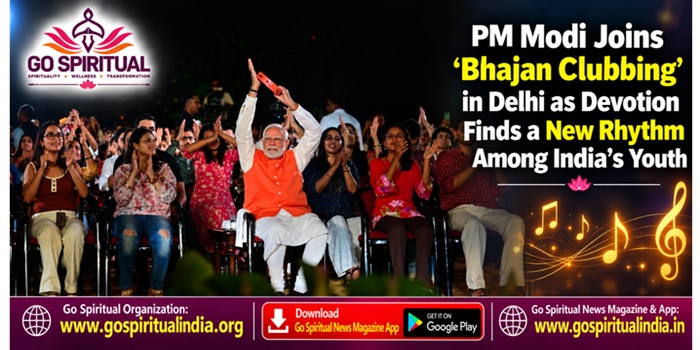

New Delhi: Prime Minister Narendra Modi joined a “Bhajan Clubbing” event in Delhi on Friday, September 25, bringing national attention to a growing cultural trend that is presenting traditional devotion in a contemporary, youth-friendly format. The event, held at Deen Dayal Upadhyaya Park near the BJP headquarters, marked the 110th birth anniversary of Pandit Deendayal Upadhyaya.
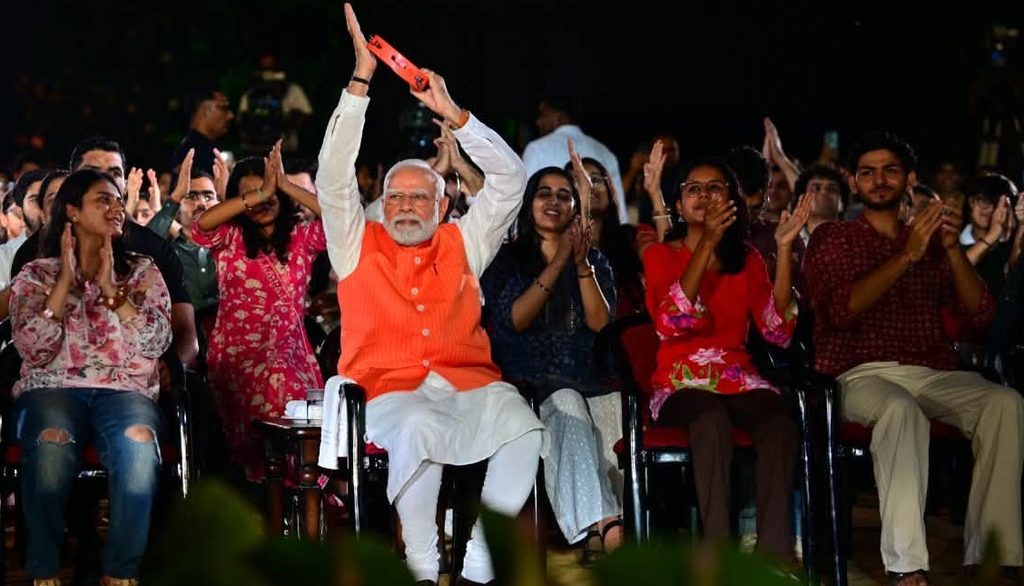
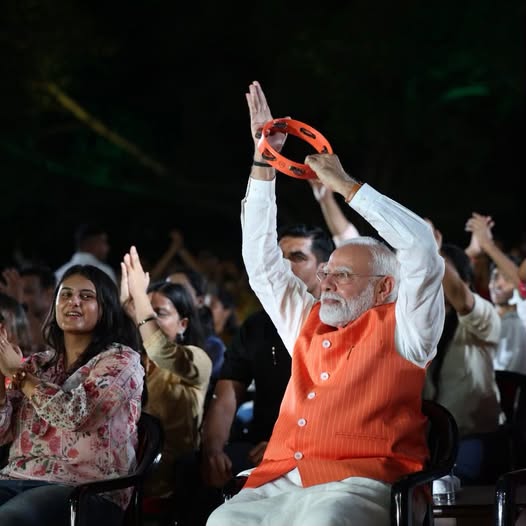
Videos from the gathering showed Modi seated among participants, clapping along with devotional music and playing a tambourine-like percussion instrument during a bhajan dedicated to Lord Ram. He also greeted the audience as he arrived at the venue.
Beyond the Prime Minister’s participation, however, the event highlighted a larger cultural phenomenon that has been gaining visibility across India: Bhajan Clubbing, a format that combines traditional bhajans, kirtans and devotional chanting with the atmosphere and production style usually associated with contemporary concerts.
There may be modern lighting, energetic music, young crowds and sophisticated sound systems, but instead of conventional club music, the gathering revolves around devotion. Participants sing, clap and sometimes dance together to bhajans and spiritual compositions. The idea is to give younger generations a space where spirituality can be experienced collectively without requiring them to disconnect completely from contemporary forms of music and social interaction.
The trend has particularly attracted attention because of the participation of young Indians. Rather than seeing spirituality only through traditional religious gatherings, temples or formal ceremonies, some young people are finding new ways to engage with devotional music and spiritual traditions.

Interestingly, Modi had earlier spoken about the phenomenon during his Mann Ki Baat programme. A Ministry of Information and Broadcasting publication on the trend described Bhajan Clubbing as a meeting point between modern presentation and traditional spiritual heritage, noting the participation of Generation Z and the use of contemporary musical arrangements while retaining the devotional essence of bhajans.
From a spiritual perspective, the popularity of such gatherings raises an interesting question: Does spirituality have to look the same in every generation?
India’s devotional traditions have never been completely static. Bhakti has historically found expression through music, poetry, storytelling, chanting and collective singing. Saints such as Kabir, Mirabai, Tulsidas and Surdas communicated spiritual ideas through forms that ordinary people could understand and experience emotionally. The instruments, presentation and social environment may change with time, but the fundamental search for connection with something beyond the material world remains.
Bhajan Clubbing can therefore be understood as another contemporary expression of an old spiritual instinct. A young person who might hesitate to attend a conventional spiritual discourse may be comfortable entering a music-driven devotional gathering with friends. If that experience encourages someone to explore the meaning behind a bhajan, understand the teachings associated with it or simply spend some time away from purely material entertainment, it can become an entry point into a deeper spiritual journey.
At the same time, the real value of such trends should ultimately be measured not by their lights, crowds, social-media videos or celebrity participation, but by whether they preserve the essence of bhakti. Spirituality is more than an atmosphere. Bhajans are not merely songs; at their deepest level, they represent remembrance, surrender, love and a search for inner connection.
That distinction becomes particularly important as spirituality increasingly enters popular culture. Modern presentation can make ancient traditions accessible, but the presentation should not become more important than the message itself. When entertainment becomes a doorway to devotion, it can create meaningful engagement. When devotion becomes merely another form of entertainment, however, its deeper purpose risks being lost.
Friday’s gathering also coincided with the birth anniversary of Pandit Deendayal Upadhyaya. Earlier in the day, Modi paid tribute to Upadhyaya and referred to his philosophy of Antyodaya, centred on the upliftment of the person at the last end of society, as an enduring inspiration for public welfare.
For the wider spiritual community, the growing popularity of Bhajan Clubbing represents an opportunity to engage a generation whose cultural habits are being shaped by smartphones, short-form videos, streaming platforms and rapidly changing forms of entertainment.
The challenge is not necessarily to ask young people to abandon modernity in order to discover spirituality. It may instead be to find meaningful ways of carrying timeless spiritual values into contemporary life without diluting their essence.
Prime Minister Modi’s participation has now given the trend considerably greater national visibility. But the more significant story may be what is happening among the young people attending these gatherings: devotional music, once assumed by some to belong primarily to temples, satsangs and older generations, is finding another stage.
The lights may be modern, the sound may be louder and the audience may be younger, but when hundreds of people come together to sing the name of Ram, Krishna or the Divine, an ancient Indian tradition is being expressed in a distinctly contemporary language.
And perhaps that is the most interesting message emerging from Bhajan Clubbing: the form of devotion can change with generations, while its spiritual essence can remain timeless.
Go Spiritual News Magazine & App
www.gospiritualindia.in
Go Spiritual Organization
www.gospiritualindia.org






One Comment