



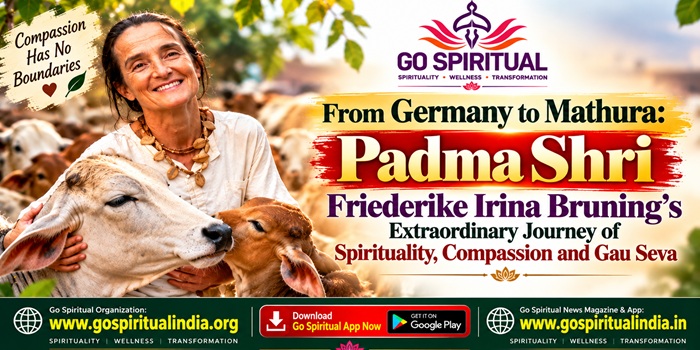

Known as Sudevi Dasi, the German-born spiritual seeker who arrived in India in 1978 has devoted decades of her life to caring for abandoned, sick, injured and disabled cows at Radha Kund, turning her spiritual search into an extraordinary example of compassion and selfless service
Mathura: In 1978, a 20-year-old woman from Berlin arrived in India while travelling across the world and searching for a deeper meaning to life. Nearly five decades later, Friederike Irina Bruning, now widely known as Sudevi Dasi or Sudevi Mataji, has become one of the most remarkable examples of how a personal spiritual journey can evolve into a lifetime of compassion and selfless service. From her home at Radha Kund in Mathura, she has dedicated decades to caring for abandoned, sick, injured and disabled cows, a mission that eventually earned her the Padma Shri, one of India’s highest civilian honours.
Born in Berlin on March 2, 1958, Bruning grew up in a Christian family. After finishing school, she began travelling in search of experience and meaning, journeying overland from Germany through Turkey, Iran and Afghanistan before reaching India. Her travels later took her through Sri Lanka and several Southeast Asian countries before she returned to India. During this period of exploration, she encountered the Bhagavad Gita, an experience that had a profound influence on the direction of her life. According to her official biography, she came to regard its teachings as a revelation of profound spiritual knowledge and decided that she needed a guru to guide her further on the spiritual path.
That search eventually brought her to Radha Kund in Govardhan, Mathura, one of the sacred centres associated with the Krishna tradition. There, she found her spiritual guru, Shri Shri 108 Shri Kishorikishoranand Goswami Babaji Maharaj, also known as Shri Tinkodi Baba Ji Maharaj, and received the initiated name Sudevi Dasi. Her official biography says she subsequently spent around two decades following her guru’s instructions and devoting herself to bhajan and spiritual practice.
Yet the defining transformation in her life came through something remarkably simple: an act of compassion towards a suffering animal.
One day, Bruning found an injured calf lying on the road with a broken leg. She brought the animal home and began caring for it. Instead of remaining an isolated act of kindness, that rescue changed the course of her life. She started taking in more cows and calves found injured, sick or abandoned on the streets. What began with one suffering calf gradually grew into Radha Surabhi Gaushala, a large Gau Seva mission at Radha Kund.

Today, her mission is associated with the care of more than 2,500 cows, according to recent accounts and information published by the gaushala. Many of these animals are not ordinary cattle requiring only food and shelter; they include abandoned, sick, injured and disabled cows and calves that need sustained attention and medical care. Her organisation has described the shelter as a sanctuary where animals that might otherwise have little chance of survival can receive food, treatment and lifelong care.
Bruning’s relationship with the animals also challenges the purely economic way in which cattle are sometimes viewed. Her mission has focused particularly on cows that are no longer useful commercially or have been abandoned because of age, illness or disability. Over the years, she has repeatedly described the cows under her care as her family. Earlier accounts of her work documented separate arrangements for animals requiring special attention, including blind and severely injured cows.
Running such a large sanctuary has required enormous financial commitment. Bruning has used her own resources, including income connected with property in Germany, to help sustain the work. Earlier reports documented substantial monthly expenses for fodder, medicines, workers and other necessities, while her family’s money also helped establish the gaushala. The scale of the operation has changed over time, but the underlying principle has remained the same: animals in distress should not be abandoned simply because caring for them is difficult or expensive.
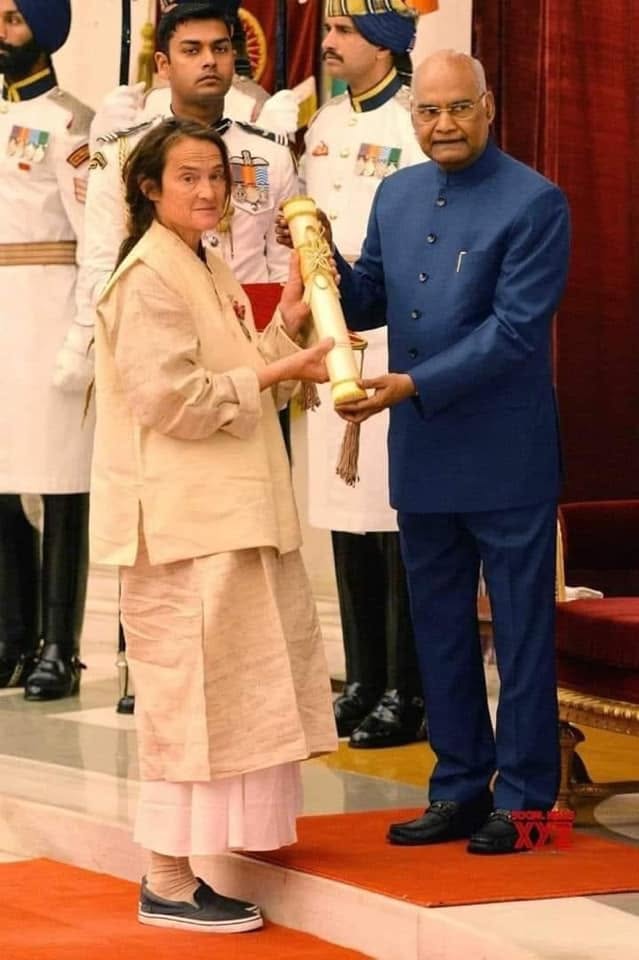
Her decades of work eventually received national recognition. In 2019, the Government of India honoured Friederike Irina Bruning with the Padma Shri for Social Work–Animal Welfare. The official Padma Awards announcement listed her as a foreign recipient from Germany in the field of animal welfare. By the time the honour arrived, the young traveller who had entered India in 1978 had already spent decades building a life around Gau Seva.
But Bruning’s story is much bigger than an award. For Go Spiritual News Magazine & App, her journey represents a powerful example of what spirituality can become when inner awakening moves beyond personal experience and expresses itself through seva, compassion and responsibility towards other living beings.
Spirituality is often associated with meditation, prayer, scriptures, pilgrimages, gurus and religious practices. These may all play an important role in a person’s spiritual journey, but the deeper question is what that journey ultimately does to the individual. Does spirituality make a person more compassionate? Does it reduce selfishness and ego? Does it make the suffering of another living being more difficult to ignore? Does inner transformation eventually become service?
Bruning’s life offers a compelling answer. She came to India searching for spiritual knowledge, but her spiritual journey eventually became inseparable from caring for living beings that could give her little or nothing in return. Her work shows that seva itself can become a form of spiritual practice.
There is a particularly important lesson in her care for sick, old and disabled animals. Compassion is easy to speak about when another living being is useful to us. Its real test comes when that being is injured, weak, ageing, abandoned or incapable of giving anything back. Caring for such animals is not a transaction. It is an expression of the belief that life possesses value beyond economic usefulness.
Her journey also gives a deeper meaning to the Indian spiritual principles of Daya, Karuna, Ahimsa and Seva. These ideas become meaningful not merely when they are discussed in scriptures or spiritual gatherings, but when they influence how human beings treat the vulnerable. Feeding a hungry animal, nursing an injured cow, giving shelter to an abandoned creature and refusing to turn away from suffering can themselves become profound spiritual acts.
At a time when spirituality is sometimes presented through claims of supernatural miracles, material blessings and instant solutions, Bruning’s life presents a very different kind of miracle. The miracle is not that something supernatural happened around her. The transformation happened within her: a young traveller’s search for spiritual meaning evolved into a commitment that has touched the lives of thousands of animals.
That transformation carries an important message. The real measure of spirituality may not be the extraordinary things a person claims to perform, but the compassion that spirituality creates within them and the good that compassion creates around them.
Bruning’s life is also an extraordinary story of crossing cultures and borders. Born thousands of kilometres away in Germany, she found her spiritual home in Braj and chose to devote much of her adult life to animals in Mathura. Her journey demonstrates that compassion does not belong to one nationality, culture or geography. When suffering is recognised and responded to with love, seva becomes a universal language.
From a 20-year-old traveller arriving in India in 1978 to Sudevi Dasi of Radha Kund, from rescuing one injured calf to caring for thousands of vulnerable cows, and from a personal search for spiritual meaning to receiving the Padma Shri for animal welfare, Friederike Irina Bruning’s life has travelled an extraordinary path.
Her story ultimately reminds us that spirituality does not have to announce itself through grand words or spectacular claims. Sometimes it can be seen most clearly in a simple decision repeated every day for decades: to see suffering, to care, and to serve.
For Go Spiritual, that may be the most inspiring message of Padma Shri Friederike Irina Bruning’s journey: when spirituality awakens compassion, compassion becomes seva; and when seva becomes a way of life, spirituality moves from belief into action.


