


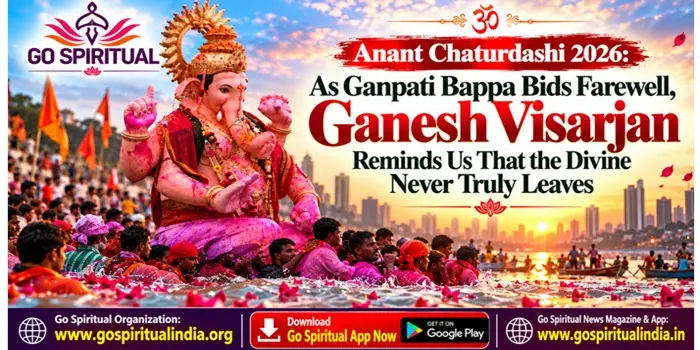

Go Spiritual reflects on the deeper message of Ganesh Visarjan—devotion beyond the idol, letting go of attachment, overcoming inner obstacles and carrying Ganesha’s wisdom, compassion and spiritual consciousness within us
Mumbai: The chants of “Ganpati Bappa Morya, Pudhchya Varshi Lavkar Ya” will echo across Mumbai, Maharashtra and many other parts of India on Friday, September 25, as devotees observe Anant Chaturdashi and bid an emotional farewell to Lord Ganesha with Ganesh Visarjan. The day marks the culmination of the major public Ganeshotsav celebrations that began with Ganesh Chaturthi on September 14 this year. Drik Panchang
For millions of devotees, Ganesh Visarjan is one of the most emotional moments of the festival. After welcoming Ganesha into homes and community pandals, performing aartis, offering modaks, praying together and celebrating his presence for several days, devotees finally carry the idol in processions for immersion. There is celebration, music and colour, but also an unmistakable feeling of separation. Yet from a spiritual perspective, Visarjan is not simply a farewell. It carries a much deeper message about life, attachment, impermanence and the eternal presence of the divine.
According to the Panchang for Mumbai, Anant Chaturdashi falls on September 25 in 2026, with the Chaturdashi Tithi beginning at 11:18 pm on September 24 and ending at 11:06 pm on September 25. Ganesh Visarjan on Anant Chaturdashi is traditionally considered the most significant immersion day of the festival. Drik Panchang
Lord Ganesha is worshipped as Vighnaharta, the remover of obstacles, as well as a symbol of wisdom, intelligence, auspicious beginnings and discernment. During Ganeshotsav, devotees invite him into their homes, but the spiritual significance of that invitation can go far beyond installing an idol. It can also be understood as an invitation to bring wisdom, humility, discipline and positivity into our own consciousness.
This is where the deeper meaning of Visarjan begins.

When an idol that has been worshipped with immense love is finally immersed, the ritual reminds us that physical forms are temporary. Everything that comes into our lives will one day change or depart. Wealth changes, success changes, relationships change, circumstances change and the human body itself is impermanent. Spirituality does not ask us to stop loving; it teaches us to love deeply without believing that we can permanently possess everything we love.
The message of Ganesh Visarjan, therefore, should not be understood as “Ganesha has gone.” The physical idol may be immersed, but the values represented by Ganesha are meant to remain within us. If we worship Ganesha for several days but return immediately to anger, greed, dishonesty, ego, jealousy and hatred, we may have completed the ritual without fully absorbing its spiritual message.
Perhaps the most meaningful Visarjan is the immersion of our inner negativity.
Let our ego be immersed. Let unnecessary anger be immersed. Let jealousy, hatred and greed be immersed. Let old resentments be immersed. Let the emotional baggage that prevents us from moving forward be immersed. And when these inner obstacles begin to dissolve, the Vighnaharta we worship externally begins to awaken within our own consciousness.
This is also why the festival has such relevance to modern life. Today, many people carry invisible burdens—professional pressure, financial worries, relationship difficulties, loneliness, anxiety, constant comparison and the relentless pressure to succeed. We often want our external problems to disappear immediately. But spirituality also asks another question: can we develop the wisdom and inner strength to face life’s difficulties differently?
Lord Ganesha’s symbolism provides a beautiful answer. His large head is commonly interpreted as an invitation to think wisely. His large ears remind us to listen. His small eyes suggest concentration and focus. His form is traditionally associated with intelligence, balance and the ability to overcome obstacles. Whether one approaches these interpretations devotionally or symbolically, their message remains deeply relevant: many of life’s obstacles require not only external solutions but also inner transformation.
Anant Chaturdashi itself adds another spiritual dimension to the day. “Anant” signifies the infinite or endless, and the observance is traditionally associated with Lord Vishnu in his Anant form. The coincidence of Ganesh Visarjan with Anant Chaturdashi creates a profound spiritual contrast: the visible form is immersed, while the eternal remains. The idol is temporary; the divine principle it represents is not.
That is perhaps one of the most beautiful lessons of the day. Spirituality gradually takes us from form to essence, possession to surrender and external worship to internal awakening.
Ganesh Visarjan can also become an occasion to reflect on our relationship with nature. If Lord Ganesha represents the sacred, then the rivers, lakes, seas, animals, trees and ecosystems around us cannot be treated as disconnected from spirituality. Devotion should not come at the cost of environmental harm. Choosing environmentally responsible idols and decorations, reducing plastic and non-biodegradable materials, avoiding unnecessary waste and participating in immersion responsibly can help bring spiritual values and environmental consciousness closer together.
A festival becomes even more meaningful when devotion creates responsibility.
The social message of Ganeshotsav is equally important. Public celebrations bring families, neighbourhoods and communities together. People who may otherwise rarely interact stand beside one another during aarti, volunteer together, distribute prasad and participate in celebrations. The festival can therefore remind society that spirituality should unite rather than divide.
When thousands of people walk together chanting “Ganpati Bappa Morya,” the moment should not end merely as a procession. It can become a collective prayer for greater wisdom, compassion, harmony and humanity.
And when the time for immersion finally arrives, perhaps our prayer to Ganesha can also change. Instead of asking only for money, success, promotion, possessions or the removal of every external difficulty, we can ask for something deeper: Give me the wisdom to make better decisions. Give me the strength to face what I cannot control. Remove the ego that prevents me from learning. Remove the anger that damages my relationships. Remove the fear that stops me from moving forward. Give me compassion so that my success never makes me insensitive to another living being.
That would make Vighnaharta not merely the remover of obstacles around us, but the remover of obstacles within us.
As the idols disappear beneath the water on Anant Chaturdashi, devotees may experience sadness, but the spiritual message is ultimately one of hope. The familiar chant itself looks towards another beginning: “Pudhchya Varshi Lavkar Ya”—come again soon next year. Visarjan therefore contains both an ending and a promise of renewal.
For Go Spiritual News Magazine & App, the deeper message of Ganesh Visarjan is simple: do not immerse Ganesha from your life when you immerse the idol. Carry his wisdom into your decisions, his ability to overcome obstacles into your difficult moments, his symbolism of auspiciousness into your actions and the spirit of devotion into the way you treat other people, animals and nature.
The idol may return to the elements, but spirituality should remain within us.
This Anant Chaturdashi, as millions say goodbye to Ganpati Bappa, the most meaningful prayer may therefore be: Bappa, take away our ego, anger, greed, hatred and negativity with you—but leave your wisdom, compassion, courage and consciousness within us.
Ganpati Bappa Morya! Pudhchya Varshi Lavkar Ya!