


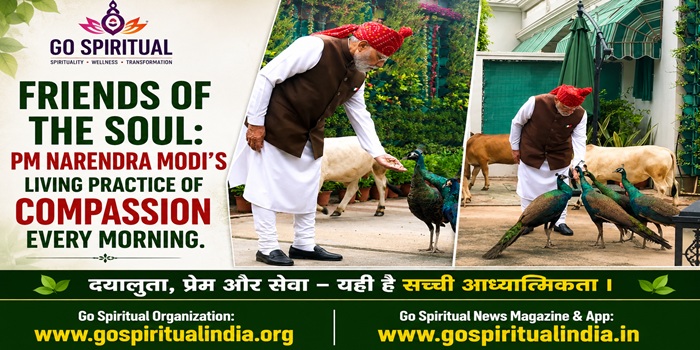

On the morning of India’s 80th Independence Day, before the grandeur of the Red Fort and the national address, Prime Minister Narendra Modi shared a quietly profound glimpse of his daily life. In a video posted on Instagram, he is seen at his residence, 7 Lok Kalyan Marg, gently feeding indigenous and miniature cows and offering grains to peacocks that have long been part of the lawns and gardens there.
“Feeding my friends every morning is a daily routine. Yesterday morning, they somehow realised I’m leaving early, so they came to meet me as I was leaving for the Red Fort. Special, as always!” he wrote.
Dressed in traditional attire for the day’s ceremonies, the Prime Minister interacted with the animals with calm affection—stroking the cows, offering them feed, and scattering grains for the peacocks that approached him. The moment, captured just before he departed for the historic fort, felt less like a political photo opportunity and more like a simple act of companionship and care.
A Daily Practice Rooted in Reverence
In the spiritual traditions of India, such everyday gestures carry deep meaning. The cow, revered as Gau Mata, is not merely livestock but a living symbol of purity, motherhood, abundance, and ahimsa (non-violence). Ancient texts and cultural practice hold the cow as a manifestation of divine grace—her presence sanctifying the space around her. Caring for cows has long been considered a form of seva, a selfless offering that purifies the heart and connects the individual to the web of life.
The peacock, India’s national bird and the vahana (vehicle) of Lord Kartikeya (Murugan), carries its own sacred symbolism. In Hindu iconography, the peacock is linked with beauty, protection, and the removal of poison—both literal and metaphorical. Its feathers adorn Lord Krishna, reminding devotees of divine play (lila) and the capacity to transform the ordinary into the extraordinary. When peacocks gather freely around a person, many traditions see it as a sign of harmony with nature and the presence of auspicious energy.

By calling these beings his “friends” and making their feeding a non-negotiable part of his morning, the Prime Minister offers a quiet reminder that spiritual life is not confined to temples or rituals alone. It is woven into the fabric of ordinary moments—walking the lawns at dawn, offering food with one’s own hands, recognising the intelligence and sensitivity of other living beings.
Leadership Through Humility and Harmony
In a world that often measures power by speed, scale, and spectacle, this small act stands out. A national leader pausing to feed cows and peacocks before addressing the nation embodies a different kind of strength—one rooted in humility, continuity with tradition, and respect for the more-than-human world. It echoes the ancient Indian ideal of living in balance with nature, where the boundaries between the human and the natural dissolve into mutual care.
Independence Day celebrates political freedom. Yet the deeper freedom that India’s spiritual heritage points toward is freedom from ego, from disconnection, and from the illusion of separateness. When a leader begins the day by honouring the sacred cow and the graceful peacock, it subtly affirms that true sovereignty includes reverence for all life.
In the quiet of that Independence Day morning, before the tricolour rose and the speeches began, the simple act of feeding “friends” became its own form of prayer—a living reminder that the divine is present not only in lofty ideals, but in the soft eyes of a cow and the iridescent feathers of a peacock waiting to be met with kindness.