





Haridwar, Uttarakhand — As the holy month of Sawan unfolds, the ancient spiritual tradition of the Kanwar Yatra once again transforms highways and pilgrimage routes into rivers of saffron faith. Millions of devotees, known as Kanwarias or Bholes, are undertaking the arduous journey to fetch sacred Ganga water and offer it at Shiva temples, reaffirming one of Hinduism’s most vibrant expressions of devotion.
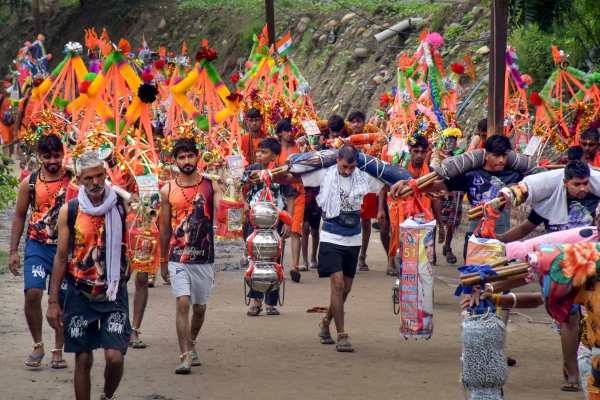
The Kanwar Yatra, named after the bamboo pole (kanwar) balanced on the shoulders carrying pots of holy water, draws pilgrims primarily to Haridwar, Gaumukh, and Gangotri in Uttarakhand, as well as Sultanganj in Bihar. From these sacred points along the Ganges, devotees carry the water—often barefoot and clad in saffron—for dozens or even hundreds of kilometers to anoint Shivalingas at local temples or renowned shrines such as Kashi Vishwanath in Varanasi, Baidyanath in Deoghar, and others across the Hindi heartland.
What began centuries ago as a quiet act of piety by ascetics and rural devotees has grown into India’s largest annual religious gathering. In recent years, estimates have placed participation at around 30 million pilgrims, mainly from Uttar Pradesh, Delhi, Haryana, Rajasthan, Punjab, Bihar, and neighboring states. The yatra typically coincides with the monsoon month of Shravan, a period specially dedicated to Lord Shiva, when Mondays are observed with fasting and heightened worship.
The practice of carrying kanwar reflects deep reverence for both the Ganga and Shiva, affectionately called Bhola or Bhole Baba. Pilgrims travel mostly on foot, though some use bicycles, motorcycles, or vehicles. Along the routes, particularly the Delhi-Haridwar highway, voluntary organizations, local Kanwar Sanghs, and spiritual groups set up camps offering free food, shelter, medical aid, and places to rest the sacred water pots. The atmosphere resonates with the chant of “Bol Bam,” a traditional call of devotion that echoes through the crowds.
Historically, the earliest recorded forms of this water-carrying pilgrimage date back to the 18th century, when devotees brought Gangajal from Sultanganj to the Baidyanath temple in Deoghar. The tradition expanded significantly from the 1960s onward and surged in popularity during the 1980s, supported by better road connectivity and growing spiritual fervor.

While the yatra is a profound celebration of faith, authorities routinely implement extensive security and traffic arrangements to manage the massive movement of people. In past years, the pilgrimage has faced interruptions, including cancellations during the COVID-19 pandemic, underscoring both its scale and the logistical challenges involved.
For the countless Kanwarias walking the long roads this season, the journey is more than a physical endurance test—it is an offering of pure devotion. As they balance the kanwar on their shoulders and chant the name of Shiva, they carry forward a living tradition that continues to bind communities in shared spiritual purpose.
In the words and footsteps of these saffron-clad pilgrims, the eternal call of “Bol Bam” rises once more, reminding the nation of the enduring power of simple, heartfelt faith.