



By Sonu Tyagi, Founder, Go Spiritual
Lord Ganesha is worshipped as the remover of obstacles, the giver of wisdom and the symbol of auspicious beginnings. Ganesh Chaturthi should therefore inspire wisdom, humility, discipline, compassion and inner purification. Unfortunately, much of what we witness today, particularly during Ganpati Visarjan, appears to have moved far away from these spiritual values. What was intended to unite society has increasingly become a competition over who can install the biggest Ganpati idol, organise the grandest procession, spend the most money and create the loudest noise.
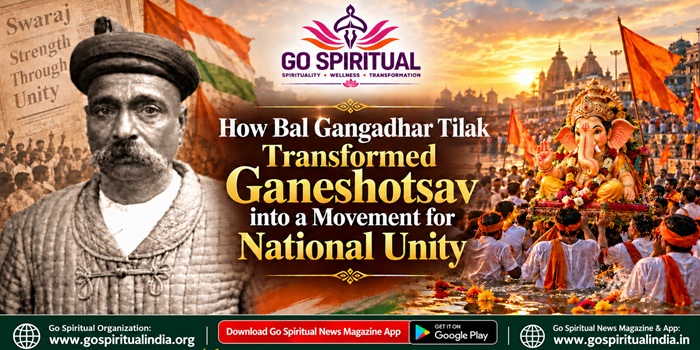
There is an important historical distinction that must first be understood. Lokmanya Bal Gangadhar Tilak did not begin the worship of Lord Ganesha or invent the ancient spiritual practice of idol immersion. Lord Ganesha had been worshipped privately in Indian homes and temples for centuries. What Tilak did in the 1890s was transform the largely private Ganesh Chaturthi celebration into an organised public festival, popularly known as Sarvajanik Ganeshotsav.
India was under British rule at the time, political gatherings faced restrictions and society remained divided by caste, class and community. Tilak understood that a public celebration centred on Lord Ganesha could bring people together on a common cultural platform. Public Ganeshotsav celebrations became spaces for patriotic speeches, cultural programmes, social awareness, community interaction and discussions about India’s freedom. The larger purpose was to awaken national consciousness, strengthen unity and mobilise people against colonial rule.
Tilak used the public Ganesh festival as a powerful means of national awakening. He did not create it as a competition for gigantic idols, deafening sound systems, vulgar dancing, political promotion or the display of money and power. Its purpose was unity, but today it often becomes competition. Its purpose was national awakening, but today it is frequently reduced to commercial promotion. Its purpose was meaningful public participation, but today it is too often associated with noise, obstruction, extravagance and spectacle.
We must therefore ask an uncomfortable but necessary question: Is this spirituality, or has it become drama?

During many immersion processions, traditional prayers and devotional songs are pushed aside by inappropriate film songs, vulgar remixes and meaningless music played at unbearable volumes. People dance as if they are participating in a commercial street show rather than respectfully bidding farewell to a sacred form of Lord Ganesha. Roads are blocked for hours, hospital patients suffer, senior citizens are disturbed, students cannot study, animals become terrified and local residents are forced to endure the celebration whether they wish to participate or not.
Can an activity that causes suffering to others honestly be called devotion? A celebration does not become spiritual merely because the name of God has been attached to it. If our way of celebrating Lord Ganesha creates obstacles for thousands of people, what message are we giving to the God we worship as the remover of obstacles?
Then there is the growing competition to create increasingly enormous idols. Every mandal appears determined to prove that its Ganpati is taller, grander and more expensive than the others. But is the physical size of an idol a measure of the depth of our faith? Does a fifty-foot idol represent greater devotion than a small clay Ganpati worshipped with honesty in an ordinary home? God cannot be measured in feet, decorations, expenditure, crowd size or social-media views. A small idol accompanied by sincere devotion is infinitely more spiritual than a gigantic idol surrounded by ego, noise and publicity.
The environmental consequences are equally troubling. Idols made with Plaster of Paris, chemical paints and non-biodegradable materials can pollute seas, rivers and lakes. Plastic, thermocol, flowers, decorations and other waste are frequently left behind at immersion sites. We call our rivers sacred and then pollute them in the name of religion. We worship nature as divine and simultaneously damage it through our rituals. This contradiction cannot be defended as faith or tradition.
The present form of competitive, noisy and environmentally destructive Ganpati Visarjan must now stop. This does not mean that devotion to Lord Ganesha should stop, nor does it mean that Ganeshotsav itself should end. It means that the drama, competition, vulgarity, noise and pollution surrounding the celebration must end. We must preserve the spiritual essence while reforming practices that harm people, animals and nature.
Families and communities can worship small idols made from natural clay. Immersion can be conducted symbolically at home or in designated artificial ponds. Public mandals can organise peaceful prayers, meditation, devotional music, community meals, blood-donation camps, educational programmes, tree plantations, assistance for poor families and environmental initiatives. Instead of spending enormous amounts of money on decorations, DJs and sound systems, that money could educate underprivileged children, support hospitals, feed hungry people, help struggling families or protect animals.
Would Lord Ganesha not be happier if a poor child received an education in His name? Would feeding a hungry person not be a greater offering than playing loud music until midnight? Would planting and protecting trees not be more sacred than polluting the sea? Would helping a distressed family overcome its difficulties not honour the remover of obstacles more meaningfully than creating obstacles on public roads?
We must also reconsider our understanding of puja. Lighting a lamp, offering flowers, performing an aarti and reciting prayers can be beautiful expressions of devotion, but rituals without truth, compassion and ethical conduct are empty. God does not need our expensive decorations, deafening music or public display. God wants us to remove ego, greed, cruelty, dishonesty, anger and selfishness from our lives.
God does not love drama; God loves reality. God is not impressed by how loudly we announce our devotion. God sees how honestly and compassionately we live when there is no crowd watching us. Real spirituality is visible in how we treat our parents, families, employees, neighbours, animals and the environment. It is reflected in whether we earn ethically, speak truthfully, help vulnerable people and show kindness to every living being.
A person may perform an elaborate puja every day, but if that person exploits others, spreads hatred, behaves dishonestly or remains indifferent to suffering, the ritual has not created spirituality. Puja should transform our character. If it does not make us more truthful, peaceful and compassionate, it has remained only an external performance.
Lord Ganesha represents wisdom. If our celebration lacks wisdom, can we honestly call it Ganeshotsav? Lord Ganesha removes obstacles. If our processions create obstacles for ambulances, patients, elderly people, working citizens and entire neighbourhoods, are we truly honouring Him? Lord Ganesha represents auspiciousness. If our celebration pollutes water and frightens animals, what is auspicious about it?
Bal Gangadhar Tilak gave public Ganeshotsav a powerful social and national purpose suited to the needs of his time. India today is independent. Our responsibility is to give the festival a peaceful, compassionate, socially meaningful and environmentally responsible purpose for our time. Let Ganeshotsav continue as a celebration of devotion, wisdom, unity and service, but let the competition, vulgar songs, deafening noise, pollution and meaningless display end.
The most meaningful visarjan is not simply the immersion of an idol in water. The real visarjan is the immersion of our ego, anger, greed, dishonesty, hatred, pretence and selfishness. When these qualities dissolve within us, Lord Ganesha truly enters our hearts. That is devotion. That is spirituality. Everything else is merely drama.
Sonu Tyagi, Founder, Go Spiritual & Approach Entertainment
Visit at www.gospiritualindia.org & www.approachentertainment.com