


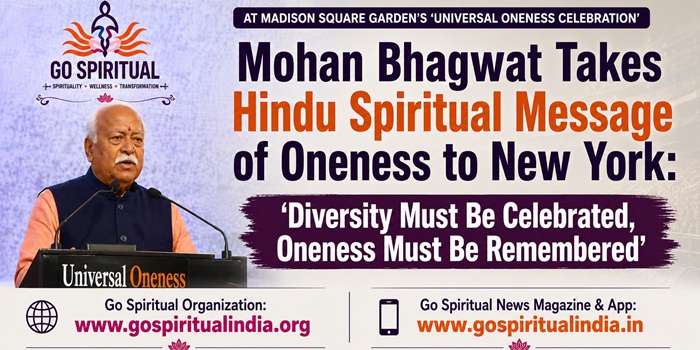

At Madison Square Garden’s Universal Oneness Celebration, RSS chief invokes Swami Vivekananda, Dharma, inner consciousness and India’s ‘unity in diversity’, presenting a vision of humanity connected beyond religion, language and nationality
New York: Rashtriya Swayamsevak Sangh (RSS) chief Mohan Bhagwat placed spirituality, Dharma and the fundamental oneness of humanity at the heart of his address at the Universal Oneness Celebration in New York, arguing that beneath the world’s extraordinary diversity lies an inner unity that connects human beings to one another.
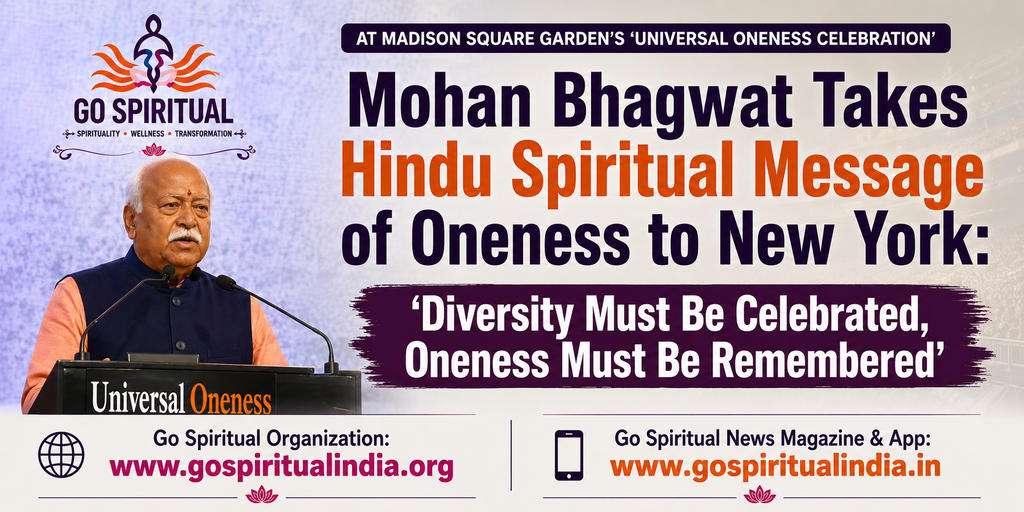
Addressing the gathering at Madison Square Garden on August 29, Bhagwat said that “unity and diversity” are embedded in the character of Bharat, while drawing a parallel with the pluralism associated with the United States. The event was organised by American Hindus for Engagement and Dialogue (AHEAD) and brought together members of the Hindu community as well as representatives from different religious traditions.
For a world increasingly divided by religion, race, nationality, ideology and identity, Bhagwat’s central message was spiritual rather than merely social: human beings may look different, live differently and follow different paths, but there is an innate oneness that connects them.
“We appear different. We are different,” Bhagwat said while explaining the material differences between individuals. Yet, he added, “there is innate oneness. That is why we feel for each other.”
Diversity Is Nature, Oneness Is the Truth
Bhagwat’s message closely reflected one of the enduring ideas of Hindu spirituality—the search for unity beneath apparent differences.

He argued that diversity should not merely be tolerated but accepted, respected, celebrated and protected. Speaking during his New York engagements, Bhagwat described diversity as a rule of nature while identifying unity as the underlying truth behind it.
At Madison Square Garden, he said diversity adds beauty to oneness rather than contradicting it.
“Diversity has to be celebrated, has to be respected, has to be accepted,” Bhagwat said, while stressing that people must simultaneously retain the consciousness of oneness.
The idea has deep resonance with the Hindu spiritual worldview that sees existence not simply as a collection of competing identities but as an interconnected whole.
For Go Spiritual, this is particularly significant. Spirituality begins to acquire its deeper meaning when an individual moves beyond the boundaries of the self and begins to recognise a connection with other human beings, animals, nature and ultimately the whole of creation.
Bharat’s Spiritual Responsibility to the World
Invoking Swami Vivekananda, Bhagwat said nations are more than geographical entities and have a larger purpose in the universe. He recalled Vivekananda’s idea that every nation has a message, a mission and a destiny.
According to Bhagwat, Bharat’s particular role is to realise—and repeatedly remind the world of—unity in diversity.
“What is the destiny given to Bharat?” he asked, before arguing that India exists to make the world realise that despite diversity, “we are one.”
The message recalls the larger civilisational spirit associated with Vasudhaiva Kutumbakam — “The World Is One Family.”
It is a philosophy that becomes especially relevant at a time when wars, religious tensions, racial divisions and competing identities continue to create conflict across societies.
Dharma Is More Than Worship
Another important spiritual dimension of Bhagwat’s speech was his explanation of Dharma.
He argued that Dharma should not simply be understood as worship or reduced to the Western understanding of religion. During his address, he described Dharma as something beyond worship and linked it to the principles that sustain harmonious life.
He also argued that individual development cannot come at the cost of society, and social progress cannot come at the expense of nature and the environment.
This understanding expands spirituality beyond temples, rituals and prayer. Dharma, in this view, becomes a way of living responsibly—with oneself, society, humanity and nature.
True Happiness Comes From Within
Bhagwat also turned attention towards a fundamental spiritual question: Where does lasting happiness come from?
His remarks contrasted material satisfaction with inner fulfilment, placing emphasis on looking inward rather than expecting possessions and consumption alone to provide lasting happiness.
The thought echoes a recurring theme across Hindu spiritual traditions—that the endless pursuit of external objects cannot permanently satisfy the human mind and that deeper peace requires inner awareness.
This distinction between temporary pleasure and lasting inner fulfilment lies at the heart of many Indian spiritual traditions, from Yoga and Vedanta to the teachings of saints and spiritual masters.
Spirituality Must Lead to Compassion and Sharing
Bhagwat did not restrict spirituality to philosophy. His remarks also connected oneness with the practical responsibility to care for others.
He spoke about the human capacity to feel another person’s hunger and suffering and stressed the importance of giving and sharing. In his wider message, he argued that what ultimately matters is not simply how much one earns but how much one is able to distribute and contribute to others.
That emphasis on service was also visible during his New York visit.
Ahead of the Madison Square Garden gathering, Bhagwat visited an ISKCON temple in New York and participated in a food-distribution initiative for homeless people. There, he spoke about Krishna consciousness as a force capable of transcending the conflicts and divisions of the contemporary world.
He said consciousness is what can unite people despite differences, and suggested that a deeper understanding that everything is connected with Krishna could help create a more harmonious world.
From Raksha Bandhan to Universal Responsibility
The symbolism of Raksha Bandhan also formed an important backdrop to the Universal Oneness Celebration.
The organisers presented the festival’s idea of bonds and responsibility in a broader context. Rather than limiting the concept of protection to a brother and sister, the event sought to extend that consciousness towards society and humanity. The gathering was promoted around the principle that unity rather than separation provides the foundation for a healthy society.
Seen spiritually, the idea can go further still: if the entire world is one family, responsibility cannot stop at one’s home, community, caste, religion or nation. It extends towards humanity, nature and all living beings.
Message to the Indian Diaspora: Respect Your Karma Bhumi
Bhagwat also delivered a notable message to Indians living abroad, asking them to recognise their responsibilities towards the country in which they live.
He urged members of the Indian diaspora in America to remain loyal to their “karma bhumi”, or the land where they live and work, while retaining their relationship with their “janma bhumi”, the land of their birth.
The message positioned Hindu civilisational identity not as isolation from other societies, but as something that can coexist with responsible citizenship and contribution to the wider community.
Event Also Draws Political Opposition
The high-profile gathering was not without controversy. New York City Mayor Zohran Mamdani had publicly said ahead of the event that he did not support the gathering and criticised what he described as an exclusionary vision associated with the RSS. He also acknowledged uncertainty over whether the city had jurisdiction to cancel a private event. The RSS has disputed accusations of intolerance and describes itself as a Hindu-centric civilisational and cultural movement.
Whatever the political debate surrounding the RSS, Bhagwat’s New York addresses placed a series of distinctly spiritual questions before the audience: Can humanity recognise its underlying oneness despite its differences? Can development coexist with responsibility towards nature? Can material prosperity be balanced with inner fulfilment? And can religious consciousness translate into compassion and service?
Hindu Spirituality and the Idea of Universal Oneness
For Go Spiritual News Magazine & App, perhaps the most significant aspect of Bhagwat’s message is the emphasis on spirituality as a force for connection rather than separation.
The Hindu spiritual tradition contains a vast range of philosophies and practices, but one of its most powerful contributions to global thought has been the idea that the divine and spiritual reality cannot be confined by external identities.
Vasudhaiva Kutumbakam asks humanity to see the world as one family. Seva transforms spirituality into service. Dharma reminds individuals of responsibility. And the search for the Atman asks human beings to look beyond their external identities towards a deeper consciousness.
At a time when technological progress is accelerating but humanity continues to struggle with conflict, loneliness, environmental destruction and social division, these ancient ideas may have an increasingly contemporary relevance.
Bhagwat’s message from New York ultimately returned to a simple spiritual proposition: diversity need not destroy unity. Humanity can remain different and still recognise that, at a deeper level, we are connected.
And perhaps that is where Hindu spirituality’s message to the modern world becomes most powerful—not in making everyone the same, but in teaching humanity to respect differences while discovering the oneness beneath them.
Go Spiritual Organization: www.gospiritualindia.org
Go Spiritual News Magazine & App: www.gospiritualindia.in