



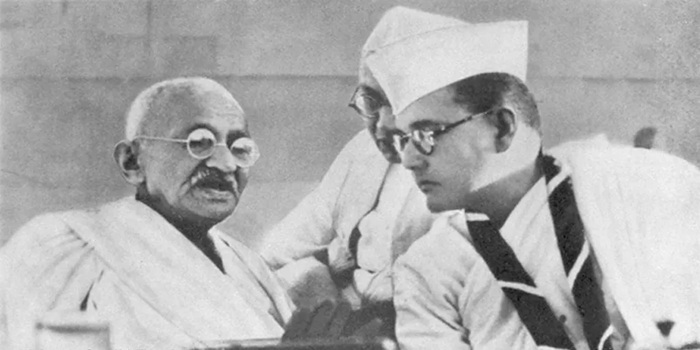

On January 23 every year, India observes Parakram Diwas (Day of Valour), commemorating the birth anniversary of one of its most charismatic and fearless freedom fighters—Netaji Subhas Chandra Bose. Born in 1897, Netaji’s life was a blazing testament to unwavering resolve, radical nationalism, and an unyielding quest for India’s complete independence. His legacy continues to inspire millions, reminding the nation that true freedom demands not just sacrifice but bold, decisive action.
Netaji was born on January 23, 1897, in Cuttack, Odisha (then part of Bengal Presidency), into a prominent Bengali family. His father, Janakinath Bose, was a successful lawyer, and his mother, Prabhavati Devi, instilled deep spiritual and moral values in him. From a young age, Subhas displayed exceptional intellect and a fiery sense of justice. He excelled in his studies, first at Presidency College in Calcutta (where he was expelled in 1916 for nationalist activities) and later at Scottish Church College, graduating in 1919.
His parents, hoping to channel his brilliance into a stable career, sent him to England to prepare for the Indian Civil Service (ICS). In 1920, Bose cleared the prestigious ICS examination with distinction, ranking fourth. Yet, the call of the motherland proved stronger. Deeply disturbed by the Jallianwala Bagh massacre and the growing nationalist fervor back home, he resigned from the ICS in April 1921, famously declaring that he could not serve an alien government while his country suffered under colonial rule.
Returning to India, Bose plunged into the freedom struggle under the banner of the Indian National Congress. He quickly rose as a dynamic leader, working closely with leaders like Chittaranjan Das, whom he regarded as a mentor. Bose advocated for complete independence (Purna Swaraj) and favored more militant, direct action over gradual reforms. He was elected President of the Indian National Congress in 1938 at Haripura and re-elected in 1939 at Tripuri, despite opposition from some senior leaders including Mahatma Gandhi. His differences with the Congress high command over strategy—particularly his insistence on immediate mass action—led him to resign and form the Forward Bloc in 1939.
The outbreak of World War II marked a turning point. Bose saw the global conflict as an opportunity to strike at British imperialism. In a daring escape from house arrest in Calcutta in January 1941, disguised as a Pathan, he traveled through Afghanistan to reach Germany. There, he sought support from the Axis powers to liberate India. Later, he journeyed to Japan via submarine, arriving in 1943 to take command of the Indian National Army (INA), or Azad Hind Fauj.

Under Netaji’s leadership, the INA grew into a formidable force of Indian prisoners of war and expatriates. He proclaimed the Provisional Government of Free India (Azad Hind) in Singapore on October 21, 1943, which was recognized by several countries. His stirring slogans—”Give me blood, and I shall give you freedom,” “Jai Hind!”, and “Dilli Chalo!” (March to Delhi)—ignited patriotic fervor. The INA fought alongside Japanese forces in Burma and Northeast India, and though militarily it faced setbacks, its trials in Red Fort after the war sparked nationwide protests and unrest, accelerating the momentum toward independence.
Netaji’s vision was progressive and inclusive. He emphasized women’s empowerment, forming the Rani of Jhansi Regiment—an all-women unit led by Captain Lakshmi Sahgal. He promoted unity across religions, castes, and regions, envisioning a strong, self-reliant, socialist India free from exploitation.
Tragically, Netaji’s life ended on August 18, 1945, reportedly in a plane crash in Taihoku (now Taipei), Taiwan. His death remains a subject of enduring mystery and speculation, with many believing he survived to return to India in disguise. Whatever the truth, his impact was profound: the INA trials and public sentiment they generated hastened Britain’s decision to leave India.
Today, on Parakram Diwas, Netaji’s ideals of courage (parakram), discipline, unity, and selfless service resonate more powerfully than ever. He taught that patriotism is action, not mere sentiment; that freedom must be fought for with determination and sacrifice. In an era of challenges, his message urges every Indian—especially the youth—to rise with valor, integrity, and collective strength to build a prosperous, united Bharat.
Netaji Subhas Chandra Bose was not just a leader; he was the embodiment of fearless spirit. His life continues to light the path for a nation that dreams big and dares greatly.
Jai Hind! Netaji Zindabad!
Go Spiritual News Magazine & App salutes the indomitable soul of Netaji Subhas Chandra Bose, whose eternal flame of courage and patriotism burns brightly in every Bharatiya heart.
Download Go Spiritual News Magazine App Now. https://play.google.com/store/apps/details?id=com.spiritual.gospiritual&hl=en_IN&pli=1